


NATO launches 3th annual challenge
NATO launches third annual
Challenge for women and girls in science
On the occasion of the International Day of Women and Girls in Science, the NATO Science and Technology Organization (STO) launches the Women and Girls in Science Challenge (WGS), inviting young women and girls from across NATO countries to imagine the future and help shape global security.
The 2026 Challenge: This year’s challenge introduces a new and innovative foresight approach, asking participants to explore fictional scenarios of disruption that test the resilience of the modern world. While the scenarios are imagined, they are rooted in real-world dependencies and emerging risks, encouraging participants to think creatively, analytically, and strategically about the future of security and defence research.
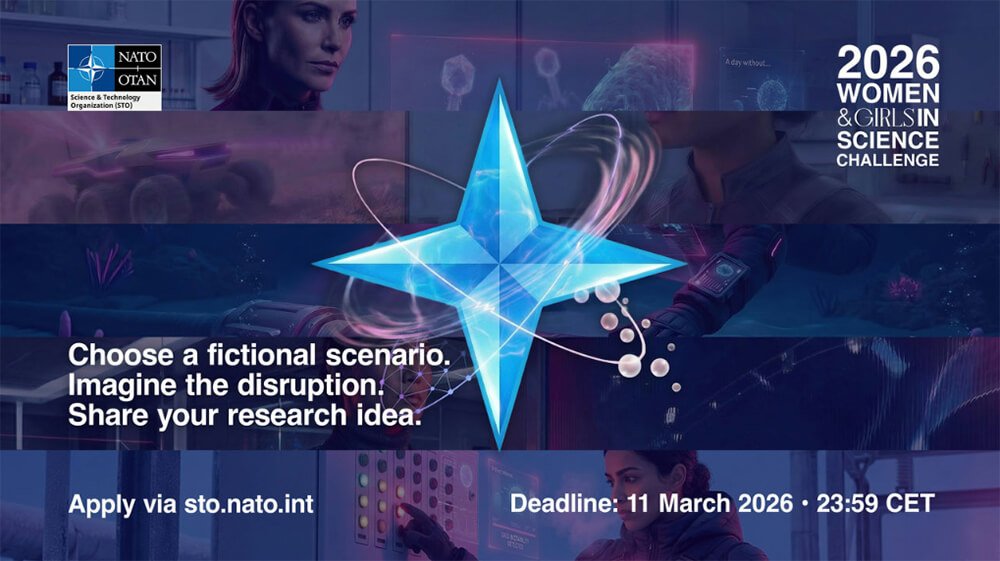
Participants are encouraged to analyse one of these scenarios and propose innovative research ideas that could help anticipate, mitigate, or adapt to such disruptions in a short proposal of up to 1,300 words.
Who can apply
Young women aged 18-35 who are nationals of NATO member countries and are enrolled in or have completed university-level studies in STEM fields (including social sciences). This challenge is open to university students (bachelor, master, PhD), early career researchers, or individuals interested in starting a career in Science, Technology, Engineering and Mathematics (STEM) and/or defence. Applications shall be submitted individually.
Selection process
NATO STO experts will select up to 12 applications based on criteria including novelty, relevance, coherence, feasibility and potential positive impact on society. The finalists will be invited to present their ideas in person at NATO Headquarters on 9 June 2026. A panel of experts will then select three overall winners.
Award
All 12 finalists will be formally recognised by the NATO Chief Scientist for their contributions to the challenge and invited to join STO’s community of alumni and STEM professionals: STEM Forward. Additionally, the three winners will benefit from a range of professional opportunities, including visits and interactions with STO staff, exposure to NATO’s scientific community, and further engagement opportunities.